$120.85$150.99
Prepare to embark on a sensory journey with the Bosco Apple, a fruit that transcends the ordinary and promises an unparalleled taste experience. These apples are nothing short of nature’s masterpiece, celebrated for their distinctive blend of flavors and their captivating visual allure.
Availability: In Stock


₹363
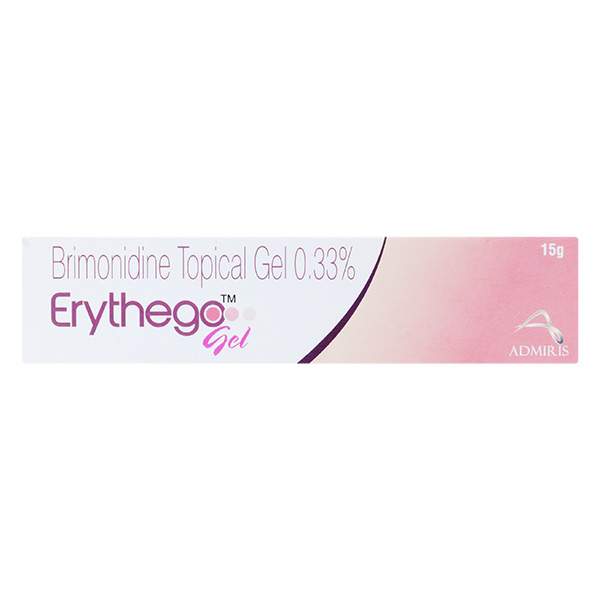
INTRODUCTION ERYTHEGO contains Brimonidine which belongs to the group of medicines called Alpha adrenergic agonists. It is used to treat redness of the facial skin caused due to rosacea. Rosacea is a skin condition characterized by flushing, skin redness with or without small red pus-filled pu...
ERYTHEGO contains Brimonidine which belongs to the group of medicines called Alpha adrenergic agonists. It is used to treat redness of the facial skin caused due to rosacea. Rosacea is a skin condition characterized by flushing, skin redness with or without small red pus-filled pustules on the skin. It happens due to increased blood flow to the facial skin which is a result of dilation of small blood vessels present in the skin.
Brimonidine acts by narrowing the small blood vessels of the skin. This reduces blood flow to the skin which in turn reduces excessive skin redness and flushing.
Apply ERYTHEGO as directed by your physician. Wait until ERYTHEGO dries on your skin before applying other skin medicines or cosmetics. Do not apply ERYTHEGO on any open wounds or cuts present in the skin.
Before starting the treatment with ERYTHEGO inform your doctor if you have or had any kidney, heart, or liver problems. You must also inform your doctor if you have any problems in blood circulation or low blood pressure or planning to do any cosmetic surgery. ERYTHEGO is not recommended for use in pregnant and breast-feeding women and in children (aged below 18 years).
While undergoing treatment with ERYTHEGO, you may also experience severe flushing of skin during the initial days (around 2 weeks) of therapy. This usually disappears after continuing the treatment for few more days in many patients. Therefore, it is important to do a patch test before initiating therapy with ERYTHEGO. Other common side effects include skin irritation or whitening of the skin at the application site. Inform your doctor if any of the above worsens.
ERYTHEGO is a potent vasoconstrictor. When applied on the skin, it causes narrowing of the small blood vessels present on the facial skin. This reduces blood flow to the skin which in turn reduces excessive skin redness and flushing.
Always apply ERYTHEGO as directed by your physician. It is for external use only. Clean and dry the affected area before application of ERYTHEGO. Apply a thin layer of ERYTHEGO on the affected area. Wash your hands before and after application. Avoid applying ERYTHEGO around your eyes, nose, or mouth.
Stop using ERYTHEGO and contact your doctor immediately if you experience any of the following side effects:
Headache:
Try to rest and relax. Apply a pain-relieving balm on your forehead. If the symptom does not improve, contact your doctor.
ERYTHEGO is not recommended for use in pregnant women. Therefore, consult your doctor before using it.
ERYTHEGO is not recommended for use in breastfeeding women. Therefore, consult your doctor before using it.
ERYTHEGO has no significant effects on the ability to drive or use machineries.
Avoid the consumption of alcohol while using ERYTHEGO as it could affect the treatment.
ERYTHEGO should be used with caution in patients with kidney diseases. Therefore, consult your doctor before using it.
ERYTHEGO should be used with caution in patients with liver diseases. Therefore, consult your doctor before using it.
Do not use ERYTHEGO if you are allergic to Brimonidine.
ERYTHEGO should be used with caution in patients with heart diseases. Therefore, consult your doctor before using it.
Before using ERYTHEGO, inform your doctor if you:
Use in pediatrics:
ERYTHEGO is not recommended for use in children and adolescents (under 18 years of age) due to lack of safety data. This is particularly important for children aged below 2 years. Therefore, consult your doctor before using it.
A. Drug-Drug Interaction:
Before using ERYTHEGO, inform your doctor if you are taking any of the following medicines such as:
Overdosage:
If you or anyone else used more ERYTHEGO or swallowed the medicine, contact your doctor immediately or visit the nearby hospital straight away. Symptoms of overdose might include skin irritation, low blood pressure, drowsiness or sleepiness, vomiting feeling tired or drowsy, abnormal heartbeats, constricted pupils, difficulty in breathing, floppiness, low body temperature and fits.
| Drug | : | Brimonidine |
| Pharmacological Category | : |
Alpha adrenergic receptor agonist |
| Therapeutic Indication | : |
Rosacea |
| Dosage Forms | : |
Eye Drops, Ophthalmic Solution, Gel |
Can ERYTHEGO be applied around on eyes?
No. ERYTHEGO should not be applied around the eyes. As the areas around the eyes are highly sensitive, keep this medicine away from your eyes or eyelids. In case of accidental contact, rinse your eyes with plenty of cold water. If irritation persists, contact your doctor for advice.
Can I stop using ERYTHEGO on my own?
No. You should not stop using ERYTHEGO on your own before finishing the course as it may cause the disease condition to return to its initial stage. Talk to your doctor if you wish to stop the treatment with [GBNKEYWORD, so that he could advice a replacement treatment. If you have any further questions on the use of this medicine, ask your doctor.
Can ERYTHEGO be used in pregnant or breast-feeding women?
No. ERYTHEGO is not recommended for use in pregnant or breast-feeding women. Discuss with your doctor if you are pregnant, planning to become pregnant or breastfeeding in between the course of ERYTHEGO therapy.
What are the precautions I should take while on the treatment with ERYTHEGO?
Before starting the treatment with ERYTHEGO inform your doctor if you have or had kidney, heart or liver diseases, blood circulation problems or fall in blood pressure. You should also inform your doctor if your skin has any open wounds or inflammation. Consult your doctor before using ERYTHEGO if you are pregnant, planning to become pregnant or breastfeeding. Do not use ERYTHEGO to treat skin conditions in toodlers aged 2 years or below.
What should I do if I forgot to use ERYTHEGO?
ERYTHEGO should be used regularly starting from the first day of treatment. If you forgot to apply this medicine at the stipulated time, apply it as soon as you remember. However, it is time for next application, skip the missed application and continue with next application at regular times. Do not apply too much of medicine at a time with a view of compensating the missed application, as this could cause skin irritation.
What should I do if I applied too much of ERYTHEGO?
If you or anyone else used more ERYTHEGO, contact your doctor immediately. Excessive application of ERYTHEGO at a particular site may cause excessive skin irritation. However, repeated administration of the medicine at the same site within the same 24 hours may make you feel dizzy while standing up or sleepy.
Can I use ERYTHEGO for my child?
No. ERYTHEGO is not recommended for use in children and adolescents (below 18 years of age). It is highly contraindicated for use in toddlers aged below 2 years. Therefore, consult your doctor before using.
Can ERYTHEGO treat acne?
No. ERYTHEGO is not meant to treat acne. It is used reduces excessive skin redness caused due to rosacea. It contains brimonidine which reduces skin redness by narrowing the small blood vessels supplying the skin.
How long does it take for ERYTHEGO show the results ?
ERYTHEGO works immediately after the application. You can experience the results as soon as after application. If your doubtful consult your doctor for advice.
Do I need prescription for ERYTHEGO?
Yes. ERYTHEGO is a prescription medicine which needs to be used only if prescribed by the physician. Kindly consult your doctor before using.
1. KD. Tripathi. Anti-Adrenergic Drugs Acting on ANS. Essentials of medical pharmacology. Seventh edition. 2013. Page – 154.
2. Joseph T. DiPiro, Robert L. Talbert. Glaucoma. Pharmacotherapy: A Pathophysiologic Approach, Eighth Edition. 2011. Page – 1643.
3. Alexis Lara Rivero, Margot Whitfeld, An update on the treatment of rosacea. NIH. National Library of Medicine, National center for biotechnology information. Pubmed central. Feb 2018. [Accessed on 14th May 2022] https://www.ncbi.nlm.nih.gov/pmc/articles/PMC5828925/
4. Laboratoires Galderma. Electronic Medicines Compendium (EMC). [Revised in Jan 2022]. [Accessed on 14th May 2022] https://www.medicines.org.uk/emc/files/pil.5303.pdf