$120.85$150.99
Prepare to embark on a sensory journey with the Bosco Apple, a fruit that transcends the ordinary and promises an unparalleled taste experience. These apples are nothing short of nature’s masterpiece, celebrated for their distinctive blend of flavors and their captivating visual allure.
Availability: In Stock


₹289
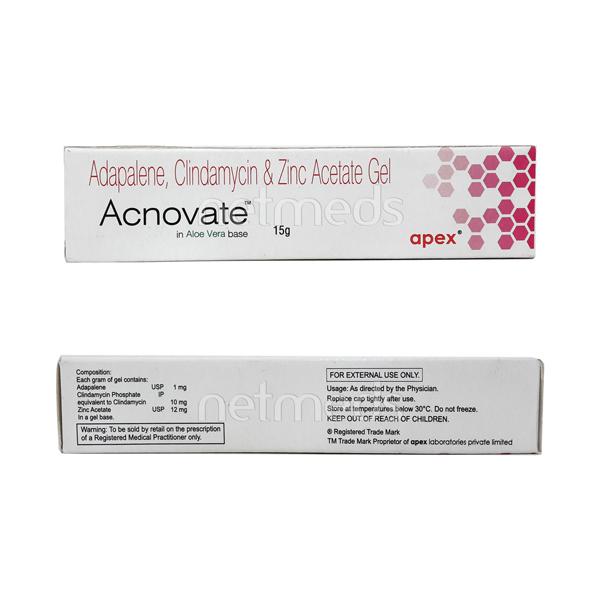
INTRODUCTION ACNOVATE GEL is a combination of Adapalene, Clindamycin and Zinc acetate which belongs to a group of medicines known as Retinoids, Antibiotics, and Minerals. It is indicated to treat acne vulgaris. Acne vulgaris is a long-term skin condition that occurs when h...
ACNOVATE GEL is a combination of Adapalene, Clindamycin and Zinc acetate which belongs to a group of medicines known as Retinoids, Antibiotics, and Minerals. It is indicated to treat acne vulgaris.
Acne vulgaris is a long-term skin condition that occurs when hair follicles plug with oil and dead skin cells which may be triggered by bacteria. It is characterised by uninflamed blackheads to pus-filled pimples or large, red and tender bumps.
Before using ACNOVATE GEL, inform your doctor if you have areas of cuts, scrapes or sunburned skin or if you have a skin condition called eczema, diarrhoea and inflammatory bowel disease.
ACNOVATE GEL is not recommended for use during pregnancy. It should be used with caution in breastfeeding woman as it is excreted in breastmilk and may pass to the baby consult your doctor for advice.
ACNOVATE GEL is not recommended for use in children and adolescents below 12 years of age. Consult with your physician.
The common side effects are skin dryness, skin irritation, urticaria (skin rash), skin oiliness, skin burning sensation. Consult your doctor if any of the symptoms worsen.
ACNOVATE GEL is a combination of adapalene, clindamycin and zinc acetate which treats pimples (acne). Adapalene is a form of vitamin A which prevents accumulation of the sebum (skin’s natural oil), unblocks the pores and allows natural exfoliation of the outer layers of skin. Clindamycin belongs to antibiotic which works by penetrating into the skin and works against acne-causing bacteria. Zinc acetate reduces the sebum production, inhibits the neutrophils and TNF production (substances responsible for inflammation), increases the tissue healing capacity and it also supress the bacterial growth.
Use as directed by your physician. It is for external use only. A thin film of ACNOVATE GEL should be applied, with the fingertips, in acne affected areas once a day after washing. Your doctor will decide the right dose depends on your age, body weight and disease condition.
Stop using ACNOVATE GEL and contact your doctor immediately if you experience any of the following side effects:
Skin rash:
Try to avoid hot showers because it may cause skin irritation. Avoid frequent contact and rubbing over the affected area. Use sunscreen and protective clothing when outdoors. If this symptom does not get better, speak to a doctor.
ACNOVATE GEL is not recommended for use during pregnancy. Consult your doctor for advice.
ACNOVATE GEL should be used with caution in breastfeeding woman as it is excreted in breastmilk and may pass to the baby. Consult your doctor for advice.
Do not use ACNOVATE GEL if you are allergic to Adapalene, Clindamycin and Zinc acetate or any other ingredients of this medicine.
Before using ACNOVATE GEL, inform your doctor if you:
Use in pediatrics:
ACNOVATE GEL is not recommended for use in children and adolescents below 12 years of age. Consult your doctor before using the medicine.
A. Drug-Drug interactions:
Before using ACNOVATE GEL inform your doctor if you are taking:
Overdosage:
If you or anyone else accidentally uses too much of ACNOVATE GEL, consult your doctor immediately or visit the nearby hospital.
| Drug | : | Adapalene, Clindamycin, Zinc acetate |
| Pharmacological Category | : | Retinoids, Lincomycin antibiotics, Minerals |
| Therapeutic Indication | : | Acne Vulgaris |
| Dosage Forms | : | Gel |
Q: What is ACNOVATE GEL and why is it given?
A: ACNOVATE GEL is a combination of Adapalene, Clindamycin, and Zinc acetate. It is indicated for treatment of Acne vulgaris characterised by uninflamed blackheads to pus-filled pimples or large, red and tender bumps.
Q: How to use ACNOVATE GEL?
A: A thin film of ACNOVATE GEL should be applied, with the fingertips, in acne affected areas once a day after washing. Dry the areas before applying and avoid contact with eyes and lips. It is for external use only.
Q: Is ACNOVATE GEL safe in pregnant and breastfeeding women?
A: ACNOVATE GEL is not recommended for use during pregnancy. It should be used with caution in breastfeeding woman as it is excreted in breastmilk and may pass to the baby. Consult your doctor for advice.
Q: Is ACNOVATE GEL safe for use in children?
A: ACNOVATE GEL is not recommended for use in children and adolescents below 12 years of age. Consult your doctor for advice before using ACNOVATE GEL.
Q: Does ACNOVATE GEL cause skin rash?
A: Yes, it may cause skin rash in some individuals. Try to avoid hot showers because it may cause skin irritation. Avoid frequent contact and rubbing over the affected area. Use sunscreen and protective clothing when outdoors. If this symptom does not get better, speak to a doctor.
1. KD. Tripathi. Drugs acting on skin and mucous membrane, Essentials of medical pharmacology. Eighth edition. 2019. Page –952, 953.
2. Mrinal Gupta, Vikram K. Mahajan, Karaninder S. Mehta, and Pushpinder S. Chauhan. Zinc Therapy in Dermatology: A Review. NIH National Library of Medicine, National center for biotechnology information. PubMed Central. July 2014. [Accessed 14th July 2022] https://www.ncbi.nlm.nih.gov/pmc/articles/PMC4120804/
3. Capitanio B., Sinagra J. L. Role of clindamycin and zinc acetate in topic acne therapy. Edizioni Minerva Medica. March 2012. [Accessed 11th August 2022] https://www.minervamedica.it/en/journals/esperienze-dermatologiche/article.php?cod=R50Y2012N01A0021&acquista=1
4. Suleyman Piskin and Erol Uzunali. A review of the use of adapalene for the treatment of acne vulgaris. A review of the use of adapalene for the treatment of acne vulgaris. NIH National Library of Medicine, National center for biotechnology information. PubMed Central. August 2007. [Accessed 14th July 2022] https://www.ncbi.nlm.nih.gov/pmc/articles/PMC2374937/
5. Patrick B. Murphy; Karlyle G. Bistas; Jacqueline K. Le. Clindamycin. NIH National Library of Medicine, National center for biotechnology information. StatPearls. May 2022. [Accessed 14th July 2022] https://www.ncbi.nlm.nih.gov/books/NBK519574 /
6. Torrent Pharmaceuticals Ltd. Revised in March 2015. [Accessed 14th July 2022] https://www.torrentian.com/pisheet/Upload/PI_Sheet/2721.pdf
7. Laboratories Galderma. Health Products Regulatory Authority (HPRA). [Revised in March 2021] [Accessed 14th July 2022] https://www.hpra.ie/img/uploaded/swedocuments/5a5e3ac1-b9a0-4dd6-816c-0313b5611f90.pdf
8. Dr. August Wolff GmbH & Co. Health Products Regulatory Authority (HPRA). [Revised in January 2021] [Accessed 11th August 2022] https://www.hpra.ie/img/uploaded/swedocuments/8e822675-a0ec-424a-89e2-d5813f57203a.pdf
Written By Dr. Janet.C, Pharm.D
Last updated on 02 Jan 2023 | 10:38 PM(IST)